Thought of the day: “Modern” human origins

The first class I took that really hooked me on paleoanthropology was an undergraduate seminar on Modern Human Origins. The class was wonderful. We read a huge amount of primary literature and for whatever reason, the class, although we were all undergraduates, were incredibly engaged and vocal on the issue, leading to great class discussions. Since I took that class almost fifteen years ago, the debate surrounding modern human origins has shifted dramatically. At the time, the narrative was dominated by the strong Out of Africa (OOA) model. Multiregional evolution was also intricately involved in our discussions, but most of the talk had to do with whether the OOA was correct or not. As such, our examination of the fossil, archaeological and genetic data was put into the context of does this refute replacement/continuity or not? Productive, yes, but also shoehorned into a necessarily simple understanding of the evolutionary processes surrounding the emergence of modernity. The shift in narratives over the past decade have made it clear that the story of the emergence of modernity is a complex evolutionary event spread out across time and space. As a result, no singular line of evidence is sufficient to address the scope of the question. Contemporary discussions of the origins of modernity are thus necessarily multi-disciplinary. The genetic, archaeological and fossil evidence are inextricably linked in the hypotheses associated with modern human origins.

Posted in Archaeology, Evolution, Fossils, Genetics | Tagged | Comments Off on Thought of the day: “Modern” human origins

Scales of time and space in prehistory

Steven Kuhn, talking about the importance of matching scales of explanation with scales of evidence (2012), and citing ecologist Simon Levin (1992):

Levin makes a parallel observation about ecological processes: “…if there are predictable patterns that may be observed in what we define as communities and ecosystems, they have arisen through the individualistic ecological and evolutionary responses of their components…” (1992, 1960). The emergent patterns that we call archaeological cultures in the Paleolithic are in some ways analogous. They are the result of countless decisions by individuals in the past, following agendas that may have been quite divergent, and that certainly had little to do with creating and maintaining what we perceive as the Mousterian, the Magdalenian or the Aurignacian. Yet the fact remains that we can identify and draw boundaries—sometimes fuzzy ones— in time and space around these entities.

*****

1. Kuhn, S. “Questions of Complexity and Scale in Explanations for Cultural Transitions in the Pleistocene: A Case Study from the Early Upper Paleolithic.” Journal of Archaeological Method and Theory: 1-18.

2. Levin, S. A. (1992). “The Problem of Pattern and Scale in Ecology: The Robert H. MacArthur Award Lecture.” Ecology 73(6): 1943-1967.

Posted in Archaeology, Evolution | Tagged , , , | Comments Off on Scales of time and space in prehistory

Gender and academic publishing

The Chronicle of Higher Education has a fascinating information graphic on the representation of women in academic publications, extending from 1665 to 2010. The graphic is based on work by Jennifer Jacquet, Jevin West and Carl Bergstrom using an index of articles and authors compiled by JSTOR. The results, not surprisingly, are that women have made dramatic gains in many fields over the past several decades but are still underrepresented as authors, lead authors and final authors, with considerable variation from subfield to subfield.

The graphic is somewhat confusingly divided into fields and subfields, but Anthropology and Physical Anthropology have their own entries. The three intervals listed are 1665-1970, 1971-1990, and 1991-2010, with the volume of authors approximately doubling with each successive time interval. Anthropology moves from 14.9% to 36.7% female authorship from beginning to end, making it one of the leading fields for women. Physical Anthropology moves from 8.9% to 27.2%. Based on the population of students and researchers at major conferences (i.e. the AAPA and AAA meetings), I imagine the numbers in both fields will jump dramatically in the next two decades. Even before arriving at Wellesley, the composition of the Anthropology classes I taught at the University of Michigan were in the 70-80% range. I would guess (and it is really a guess) that AAA attendance is near that range, as well. Representation of women at AAPAs is less, though amongst graduate students I think women are in the majority. The differences by sub-field are particularly noticeable in the AAPA, with sub-fields like primatology and human behavioral ecology seemingly having a high percentage of women, with women less represented in functional morphology and (maybe) genetics. “Human origins,” the subfield that seems to most closely match “paleoanthropology” is listed as having 26% female authorship from 1991-2010. Again, I think this significantly underestimates the current composition of the field (and not just because my most recent field school, Dmanisi 2011, was entirely female). At the senior level, of course, this is not the case. There is a temporal scale to academic training, careers and publication, creating a lag between the composition of the field at a graduate training level and the distribution of publications.

More gender equity in the field is a good thing. We live in highly gendered societies and in the attempt to achieve objectivity in research it is extraordinarily difficult to escape that reality. Having a more balanced representation in publication makes our bias less of an issue.

Differences in the composition of undergraduate and graduate classes is not the only factor impacting publication rates, however. My wife, who is a 17th century French lit scholar, is currently working on a piece for a volume on women in academia. Again, the gendered nature of society puts a lot of roadblocks, drags, etc. on women in the field.

Posted in Anthropology | Tagged , , , | Comments Off on Gender and academic publishing

Weekend wag the dog(s): The canine trisomy

Our two dogs were joined by a third this week, as we took in my mother-in-law’s dog while she tries to get over a case of bronchitis.

When walking our two dogs, their leashes regularly become intertwined and untwined from one another in a manner not unlike the double helix structure of DNA. My brief experiment with three dogs quickly revealed the more complicated spatial dynamics of the triple helix. Sometimes less is more.

Posted in Uncategorized | Tagged | Comments Off on Weekend wag the dog(s): The canine trisomy

New year, new site banner

In honor of my 1-year blogging anniversary, I have changed the site header. The old photo was a picture taken looking out over the Eastern slope of the Tugen Hills region, in the Central Rift Valley of Kenya. I tagged along on a project in the area led by Katie Binetti in 2004.

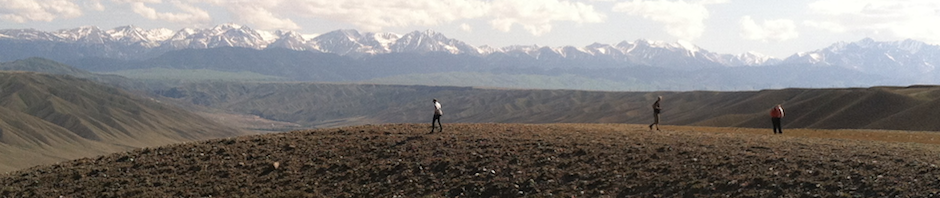
The new image comes from Dmanisi, a place I have become very familiar with over the past decade. This view shows the medieval citadel complex with the Masavera valley in the background. The paleolithic excavations are focused in the area just to the right of this shot.

Posted in Uncategorized | Tagged , , | Comments Off on New year, new site banner

Coursera banned (sort of) from Minnesota

Coursera, one of the growing number of open access, online education platforms (developed in partnership with Stanford University), has been banned from Minnesota. The Chronicle reports:

The state’s Office of Higher Education has informed the popular provider of massive open online courses, or MOOC’s, that Coursera is unwelcome in the state because it never got permission to operate there. It’s unclear how the law could be enforced when the content is freely available on the Web, but Coursera updated its Terms of Service to include the following caution:

Notice for Minnesota Users:

Coursera has been informed by the Minnesota Office of Higher Education that under Minnesota Statutes (136A.61 to 136A.71), a university cannot offer online courses to Minnesota residents unless the university has received authorization from the State of Minnesota to do so. If you are a resident of Minnesota, you agree that either (1) you will not take courses on Coursera, or (2) for each class that you take, the majority of work you do for the class will be done from outside the State of Minnesota.

Interesting. Not sure about how it could be enforced, but this strikes me as a somewhat surprising pushback against online education (of which there are many less surprising potential sources of pushback).

Posted in Teaching | Tagged , | Comments Off on Coursera banned (sort of) from Minnesota

One-year blogiversary

A year ago today I went live with the blog, putting up a post titled, “What is wrong with Anthropology,” written in response to Florida Gov. Rick Scott’s calling out of the field:

This blog is in some ways my response to these discussions. I agree with the discussions linked above that anthropologists need to be proactive in engaging with the public on issues related to our field. As a biological anthropologist, these issues are many and varied. My own work focuses on evolutionary events spanning the last several million years. Although this is a subject that is at times, quite literally, buried in the past, it has repercussions for how we understand what it means to be human, how we confront change in the world around us and within us, and how we deal with the complex set of interactions that shape how we approach the world each day.

Over the past twelve months I have posted a number of other commentaries on why I blog, but a year into it, I find it worth reflecting on the experience.

First, I have found the experience and process of carrying on a professional/academic blog extremely rewarding. I can pretty much divide the tasks and rewards of blogging into three areas:

I read – The pressure of keeping the blog up has provided an organizational structure that has better enabled me to keep up with the current literature. This is aided tremendously by being connected to a cohort of people via twitter, RSS feeds, Facebook and e-mail helping to keep me informed about new and interesting publications across a variety of fields and subfields of interest to me and my work. I have always read, but the blog helps provide a positive external pressure to do so, and do so efficiently and effectively.

I write – Writing is a skill that requires practice. For the most part, the more you write, the better you write. The blog gets me writing. Some of it is silly, much of it is informal (or at least less formal than a published article), but it is all organizing, integrating and communicating thinking…in other words, writing. I have made 178 posts over the past year, at various times falling off the map for weeks at a time as other work (and life) piled up. The commitment of time and energy is real, not virtual.

I communicate – One of the most enjoyable aspects of blogging has been that it has connected me to a much larger group of people than I would otherwise regularly interact. I am in a small Anthropology Department at a small Liberal Arts College. I am the lone biological anthropologist. I am one of two people on campus who does paleo-related research. The blog has made me part of a virtual faculty that has helped facilitate the kinds of discussions and thinking that I did as a graduate student as part of a large, four-field Anthropology Department within an even larger, research University. This makes me both better at what I do and happier doing it.

A few other assorted thoughts…

The popularity of my blog is extremely modest by internet standards, and yet the site has logged more than 22,000 visits in the past twelve months. While modest, that number represents a dramatically larger audience than sees my peer-reviewed journal publications.

Those 22,000 visitors have come from 124 different countries. Roughly 2/3 of my audience has been from the United States, the U.K. and Canada represent another 10%, and the remaining quarter is distributed fairly widely across the globe. The biggest absence in my global footprint is in Africa, particularly Central and West Africa.

The most popular search topics that have led to my blog are issues related to the usefulness of Anthropology (and my defense of the field), evolutionary paleodiet questions (apparently there are a lot of paleo-dieters these days) and race and IQ. The single most popular post I have made related to that terrible video produced by the EU of women in science, that was picked up by Wired’s coverage of the story.

Here’s to hoping for an even better next 12 months…

Posted in Uncategorized | Tagged , | Comments Off on One-year blogiversary

Lifespan and condition-dependent mortality

Following up on my post from yesterday on the evolutionary history of human longevity, there is a timely article out today in Current Biology on lifespan and condition-dependent mortality. The paper, by Hwei-Yen Chen and Alexei Maklakov, uses an experimental nematode model to play around with random versus non-random, or environmental/condition-dependent, sources of mortality:

We provide experimental evidence for the theory that aging evolves via condition-environment interactions. We show that when selection is condition dependent, high mortality rate leads to the evolution of increased longevity, defined here as mean adult life span in the absence of extrinsic mortality hazard. In order to test the evolutionary theories of aging, one must separate the effects of mortality rate (i.e., high versus low) and mortality source (random versus condi- tion dependent).

Again, playing off what I wrote yesterday, human populations can be subject to highly varied, but relatively stable, condition-environment interactions impacting rates of mortality. Environmental hazards across different environments, differing levels of intra-group and/or inter-group violence, dispersal patterns, and food acquisition/production risk are all examples of such potential relationships.

*****

1. Chen, H.-y. and A. A. Maklakov (2012). “Longer Life Span Evolves under High Rates of Condition-Dependent Mortality.” Current biology : CB. DOI 10.1016/j.cub.2012.09.021

Posted in Demography | Tagged , , | Comments Off on Lifespan and condition-dependent mortality

Human longevity in prehistory

A new article in PNAS, authored by Oskar Burger, Annette Baudisch and James Vaupel, is gathering some attention to the issue of the evolutionary history of human demography and longevity. The article itself covers a lot of old ground (excuse the pun) in terms of patterns of human demography, relying heavily on data gathered by Michael Gurven and Hillard Kaplan for a 2007 article on the topic (Gurven & Kaplan, 2007). The new study, as reported by Science News, finds that only recently have humans begun to regularly live a long time:

“It’s amazing what clean water and a bit of extra food gets you,” says Berger, of the Max Planck Institute for Demographic Research in Rostock, Germany.

A 30-year-old hunter-gatherer has the same probability of death as a Japanese person today who is 72 years old, the study found. At 15, a hunter-gatherer has a 1.3 percent probability of dying in the next year; Swedes hit those odds at age 69.

As I said, many of the findings in the current study can be seen in the longer 2007 piece by Gurven and Kaplan. In that article, the researchers attempted to assemble the most complete record available of high-quality demographic studies of contemporary hunter-gatherer populations, making distinctions between the degree of acculturation or horticulturation present within those groups.

The discussion reminds me of an important classic article by the archaeologist Martin Wobst on “the tyranny of the ethnographic record” (Wobst, 1978). There is a tremendous appeal to bringing empirical data to the discussion of a complex theoretical issue like human demography. And yet, simply because the data are empirical does not mean they are appropriate. I have discussed this before, but one of the great challenges in paleoanthropology is the identification of appropriate comparisons across time and space. The contemporary demography of populations occupying different regions in different circumstances is tremendously value to our understanding of these issues on both a theoretical and practical level. However, simply because they are valuable does not mean they represent an appropriate analog for thinking about events across evolutionary time.

A few things that I think can be said about evolutionary demographic changes in humans:

1) There have been genetic changes in recent humans that play a role in reduced mortality, increased longevity

The expansion in human population size over the last 15,000 year and expansion into and modification of a host of different environments has created a strong selective environment on humans. Surely, some of this selection has found its way to genetic characters associated with fertility, mortality and longevity. Some of these novel genetic elements are probably shared throughout our species, some are likely present at differential frequencies within and between populations.

2) Whatever genetic changes have occurred, most of the variation in contemporary demographic parameters results from cultural/technological differences, not genetic differences

Yes, there have been genetic changes in humans of demographic significance. But the reality is that the biggest drivers of the key demographic parameters are cultural. How populations relate to their environment, how they relate to each other, and how they conceptualize reproduction and survival–while certainly not abiological–are dominated by culturally produced, encoded, and inherited constructs. This is evident even in the PNAS paper:

The variation between the highest and lowest mortality populations is remarkably large (Fig. 1B). The lowest age-specific death rates are enjoyed by the current populations of countries such as Japan and Sweden. The worst-case mortality for humans is approximated by 19th century slaves on Trinidad, who suffered death rates at all ages that were higher than those for hunter- gatherers.

This large variation in mortality is the product, primarily, of cultural forces, not biological differences. I would point out that Figure 9 from the Gurven & Kaplan paper (pasted below) also points to this issue:

3) The implication of the above two statements for the evolutionary history of humans is not entirely obvious

If such tremendous variation exists across contemporary populations, it is easy to accept that such variation may have existed in the past. Not that a large number of prehistoric populations would have had massively reduced adult mortality or extended longevity, but that the occupation of varied environments, the differential application of technology to ecological issues pertaining to fertility/mortality, and different cultural practices would likely have supported considerable variation in prehistoric demographic patterns. The general U-shaped mortality pattern associated with humans I think is likely valid throughout prehistory, but the location of modal longevity expectations, the distribution of mortality risk both early in life and later in life, and varying fertility curves could have created a lot of viable and differing demographic profiles.

Wanting to stay true to my pledge to share more math, consider the following age-specific survivorship function l(x) using a Siler mortality hazard model:

This functions gives you the survivorship likelihood at age x given an initial infant mortality rate (a1), age-independent mortality (a2), initial adult mortality rate (a3), rate of mortality decline (b1), and the rate of mortality increase (b3). The nature of these mathematical relationships means that even small shifts in the underlying parameters can lead very quickly to large changes in the observed demographic patterns. We know that living populations do have different parameter inputs into this model, which much of the difference coming from differing cultural/environmental components.

Going back to Wobst’s complaints about the tyranny of the ethnographic record, I think it is wonderful to have the kind of compiled data put together by Gurven and Kaplan to empirically address and model demographic issues. I doubt, however, that contemporary hunter-gatherer groups adequately sample the range of demographic variation present in our evolutionary past. As just one example, even for the more un-acculturated hunter-gatherer groups identified by Gurven & Kaplan, they still exist in a world of several billion people, which by itself changes the global evolutionary playing field for infectious diseases and parasites. A minimally acculturated hunter-gatherer group is not a Late Pleistocene population of hunter-gatherers. As such, the challenge of extrapolating deep evolutionary patterns based on that assumption, which I think is at least part of what the PNAS paper’s authors are doing, is problematic. Mind you, it is an endeavor that I like and would like to see more critical discussion of, as I think the demographic realities and variation in our evolutionary past are a critical component of the human evolutionary story.

*****

1. Burger, O., A. Baudisch, et al. (2012). “Human mortality improvement in evolutionary context.” Proceedings of the National Academy of Sciences. doi: 10.1073/pnas.1215627109

2. Gurven, M. and H. Kaplan (2007). “Longevity among Hunter-Gatherers: A Cross-Cultural Examination.” Population and Development Review 33(2): 321-365. E-ISSN: 17284457

3. Wobst, H. M. (1978). “The Archaeo-Ethnology of Hunter-Gatherers or the Tyranny of the Ethnographic Record in Archaeology.” American Antiquity 43(2): 303-309. ISSN: 00027316
Posted in Demography, Ethnography, Evolution | Tagged , , , | Comments Off on Human longevity in prehistory

Links for a Monday morning

Some readings from around the web to start the week…

Estimating the rate of mutation and the human evolutionary clock
This is a big , complex and unfolding story that I have been meaning to comment on and still hope to in the near future. Basically, over the past several years studies that employ genomic approaches towards directly estimating the mutation rate in humans have been coming up with estimates considerably slower than previously thought. This, if true, has significant ramifications for the estimated timing of key human evolutionary events (e.g. the human-Pan last common ancestor, the human-Neandertal divergence). As I say though, the issue is complex, with significant assumptions across the varying interpretations. As some initial reading…

Ann Gibbons has a piece discussing this issue in Science:
Turning Back the Clock: Slowing the Pace of Prehistory

Matthew Cobb has a piece up at Why Evolution is True:
Putting our DNA clocks back

There are other significant commentaries on this issue that I’ll link to in my own comments…hopefully later this week.

Sex and Gender in the osteological record
Debating Biology and Culture at Bones Don’t Lie

Examining the culture of science
Anne Buchanan at The Mermaid’s Tale tell us that Science denial — it may be closer than you think

People with whom we’d probably share a lot in terms of our outlook on the world, on science, most of our understanding of the foundation of genetics and so on. But not on the quality of the evidence in this instance, and thus on whether direct-to-consumer companies are shilling, or should be selling what they are. This of course doesn’t make us right and everyone else wrong. It just means we’re either evaluating the same evidence differently or considering different pieces of evidence.

Connecting the personal and social in medicine
Daniel Lende, writing that Personalized Medicine Is Social Medicine

In other words, “personalized medicine” cannot be disembodied medicine, forgetting the reciprocal interactions between the person’s nervous system and the developmental and social processes that help define who that person is, not just in the sense of identity but also at the level of basic neurological function. Personalized inevitably is social; personalized medicine should be too.

The election and Anthropology
Politics & Anthropology in Election Year – 2012 Obama Romney

The limits and realities of human nature and inequality
Is inequality natural – Agustin Fuentes

Scientific retractions
Carl Zimmer, writing in the New York Times, talks about the growing issue of scientific retractions: Misconduct Widespread in Retracted Science Papers, Study Finds

Sushi…mmm
Finally, for my Anthropology of Food students, Keith Law reviews Jiro Dreams of Sushi

Posted in Brain, Evolution, Food, Genetics | Tagged , , , , , | Comments Off on Links for a Monday morning